Multilingual Insurance Claim Intake with AI: ACORD Forms and Clients Who Do Not Speak English

Insurance brokers across the US, UK, and EU serve more non-English clients every year. New York's outer boroughs, Miami-Dade, Houston's east side, London's east, Paris's banlieues, Berlin's Kreuzberg. The clients run bodegas, restaurants, contracting crews, ride-share fleets, and home-care agencies. They speak Spanish, Arabic, French, Mandarin, and Urdu at home. They need ACORD forms filled in English.
ACORD forms are English-only by design and that is not going to change. The fix is not to translate the forms; it is to translate the intake. AI handles the language gap so a 50-minute call-and-translate session becomes a 5-minute intake plus a 30-second broker review.
The ACORD forms that come up most
Four forms cover most multilingual intake in commercial lines:
- ACORD 25 — Certificate of Insurance. The proof-of-coverage one-pager that landlords, general contractors, and clients ask for before they will sign a lease or contract.
- ACORD 125 — Commercial Insurance Application. The base business application: legal entity, FEIN, mailing address, SIC code, years in business, gross annual sales.
- ACORD 140 — Property. Building info, occupancy, construction type, protection class, coinsurance.
- ACORD 130 — Workers Compensation. Payroll by class code, owner officer info, prior carrier history.
If you write personal lines, ACORD 90 (Personal Auto) and ACORD 80 (Homeowners) carry equivalent weight. The intake pattern is the same. The fields are different.
Every one of these forms is English-only. They flow through carrier APIs that expect English field labels and US-format addresses, dates, and currency. Bilingual forms are not coming. Translated intake is.
Where the language barrier actually shows up
It is rarely at the keyboard. The broker can type. The bottleneck is upstream: the client cannot read the ACORD field labels, does not know what FEIN means, has never heard the phrase "named insured", and is trying to describe a 2019 Toyota Sienna in Spanish over a WhatsApp voice note from their cousin's phone.
Three intake channels dominate:
- Voice calls. The client calls in Spanish or Arabic. The agency office speaks English. Today: a bilingual employee translates live, slowing both sides. Tomorrow: the call is transcribed in the original language, then the AI extracts the structured data and outputs the ACORD draft in English.
- WhatsApp photos and voice notes. A body shop sends a photo of a vehicle title in Spanish. A contractor sends a voice note in Arabic describing a slip-and-fall claim. The phone screen replaces the office reception desk. AI reads the photo, transcribes the voice, and pre-fills the ACORD claim notice.
- Hand-written forms. Older clients still prefer paper. They fill an intake form at the agent's desk in Arabic, French, or Spanish. The broker scans it, runs OCR with language detection, and the AI translates the fields onto the right ACORD locations.
In all three cases the client never touches the ACORD form. They speak, write, or photograph in their own language. The English form is the broker's working surface, not the client's.
How the data actually moves
The map is short:
| Step | What happens | Time |
|---|---|---|
| 1. Intake capture | Voice call, WhatsApp message, scanned form, or handwritten note in client's language | as long as the call takes |
| 2. Transcription / OCR | Whisper-class STT or vision OCR with explicit language hint (es, ar, fr) | 5-30 seconds |
| 3. Field extraction | LLM with ACORD form schema as the target. Output: structured JSON keyed by ACORD field name | 30-90 seconds |
| 4. Form fill | Pre-fill the ACORD PDF or carrier portal from the JSON | instant |
| 5. Broker review | 30 seconds: scan for name spelling, dates, currency, anything flagged as low-confidence | 30 seconds |
| 6. Signature and send | DocuSign or wet signature, then carrier submission | 1-2 minutes |
The whole pipeline runs in under five minutes for a clean ACORD 25. ACORD 125 with full underwriting questions takes longer because there are more fields, not because the AI is slower.
The translation calls that matter
Some fields translate cleanly. A street address in Spanish or French is still a street address; the AI swaps comma-decimal for period-decimal and reformats to USPS standards.
Some do not:
- Names with non-Latin scripts. Arabic, Cyrillic, Chinese. The ACORD field needs one canonical Latin spelling that matches the client's government ID. Default to passport or driver's license spelling. Keep the original script in your CRM.
- Dual-script businesses. A storefront sign that reads "مطعم الحمراء — Al-Hamra Restaurant" needs the legal entity name from the LLC filing, not the storefront. AI flags the mismatch; broker confirms with the client.
- Dates. dd/mm/yyyy from the client, mm/dd/yyyy on the form. Convert on the way in.
- Currency. Annual sales given in pesos or dirhams must be converted to USD/GBP/EUR at a posted rate, with the rate and date in the audit trail.
- Address types. "Calle" and "Avenida" become "Street" and "Avenue". "rue" and "boulevard" become "Street" and "Boulevard". The carrier system parses USPS street suffixes; localized words break the parse.
Where AI fits, where the broker fits
AI does the data capture and the language layer. The broker still owns:
- Coverage decisions (limits, deductibles, endorsements).
- Carrier selection.
- The signature and the E&O liability.
- The judgment call when AI flags a low-confidence field.
What you save: the 30-40 minutes per client that used to go to ask, translate, retype, and re-ask. What you keep: the broker as the human in the loop, signing every form. For the broader pattern of turning unstructured input into a fillable form, see scanned PDF to fillable form. For another multilingual workflow in a regulated US system, see Spanish-language US immigration forms.
What to try this week
Pick one ACORD form your agency fills most often. For most commercial books that is ACORD 25 or ACORD 125. Take the last three non-English client intakes you ran the long way. Re-run them through an AI intake pipeline: transcribe the call in the original language, extract to JSON keyed by ACORD field, fill the PDF. Time it. Compare to your old workflow. If you saved 25 minutes per client and three clients a day, that is a senior broker afternoon back, every day.
Checklist
- Capture intake in the client's language first. Voice in Spanish, WhatsApp in Arabic, handwritten in French — get the raw data, do not ask the client to translate themselves.
- Run the input through AI extraction with the target ACORD form as schema. ACORD 25 needs the named insured, certificate holder, and policy numbers. ACORD 125 needs business info, FEIN, and SIC code.
- Map dual-script names carefully. José Martínez and يوسف الحداد both need a Latin-letter representation on the ACORD form, with the original kept in your CRM for reference.
- Convert dates and addresses to US/UK format on the form. The client said dd/mm/yyyy; the ACORD field wants mm/dd/yyyy. Get this wrong and the carrier rejects it.
- Always show the filled ACORD to the broker for a 30-second review before sending. The client never sees the English form; the broker is the human in the loop.
Related articles
 Tool Comparisons
Adobe Fill & Sign Alternative When Autofill Suggests the Wrong Name
Adobe Fill & Sign remembers more than you want. Wrong name. Previous customer's signature. Private medical details on the next PDF. This guide covers when to clear the cache, when to keep Acrobat, and when a reusable profile is the safer Adobe Fill & Sign alternative.
8 min readRead more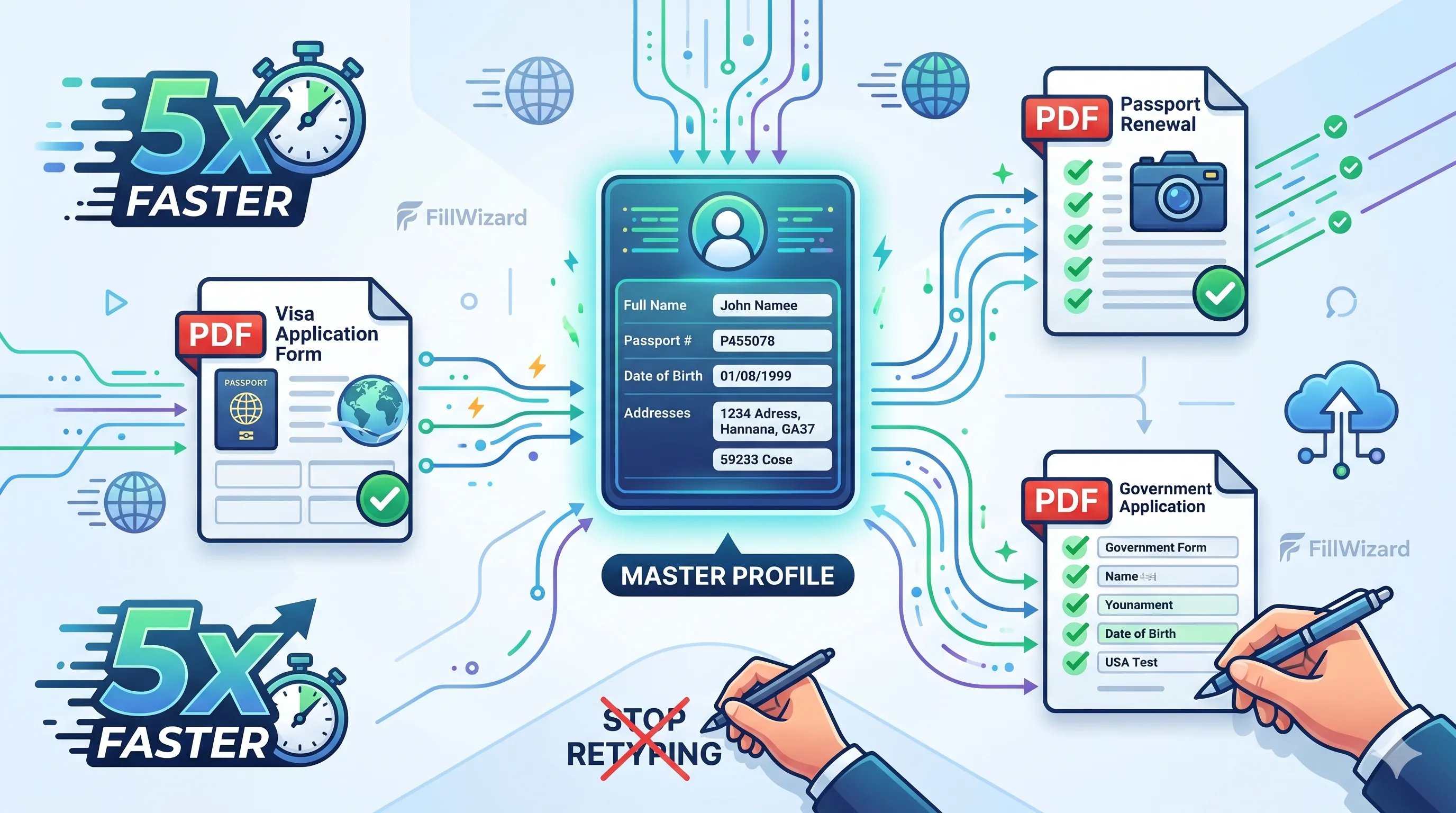 Productivity
How to Batch Fill PDF Forms from a Profile (Without Mail-Merge Pain)
Batch fill and prefill should mean enter once, fill many PDFs. Mail merge for fillable forms is the old workaround. A profile is the cleaner version of the same idea.
9 min readRead more Visa Workflows
DS-160 Family Application: Why the Family Button Still Makes You Retype Everything
A DS-160 family application is still one form per person. The family button on CEAC does almost nothing for shared fields. Profiles fix the retyping. CEAC still gets the final submit.
9 min readRead more